Understanding the 4Cs of Diamonds: Cut, Color, Clarity & Carat — A Buyer's Guide
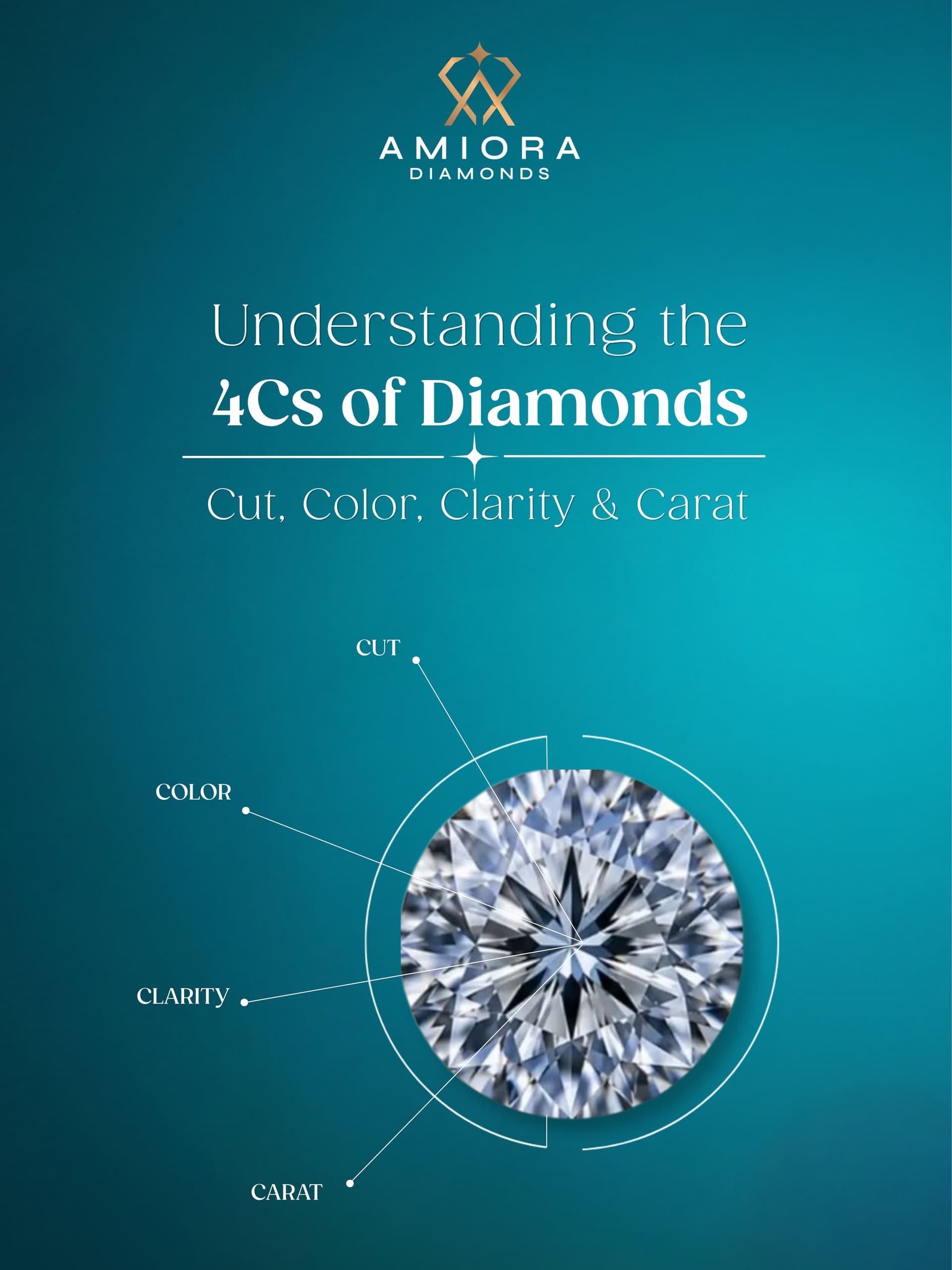
Walk into any jewellery store and ask about a diamond, and you'll almost certainly hear four words repeated: cut, color, clarity, carat. These are the 4Cs — the universal language of diamond quality, developed to give buyers a consistent, honest way to compare one stone against another. And yet, most people walk into a purchase this significant without truly understanding what these terms mean, or which ones actually matter most for the way a diamond looks and feels on the hand.
At Amiora Diamonds, we believe an informed buyer is a confident buyer. This guide breaks the 4Cs down in plain language, explains how they work together, and shows you exactly where to spend your budget for maximum brilliance — whether you're choosing a natural diamond or a certified lab grown one.
What Are the 4Cs of Diamonds?
The 4Cs framework was developed by the Gemological Institute of America (GIA) to standardise diamond grading worldwide. Before this system existed, diamond quality was largely subjective — buyers had no reliable way to compare stones or verify what they were paying for. Today, the 4Cs are the backbone of every diamond grading report, whether issued by GIA, IGI, or another recognised laboratory.
The four factors are:
1. Cut — how well the diamond is proportioned and faceted
2. Color — how colorless (or tinted) the diamond appears
3. Clarity — how free the diamond is from internal and external imperfections
4. Carat — the diamond's weight, and by extension, its size
Each of these plays a distinct role in a diamond's beauty and price. Understanding how they interact — rather than treating them as separate checkboxes — is the real key to buying smart.
Cut: The Most Important C
If there's one factor to prioritise above all others, it's cut. Cut refers to how precisely a diamond's facets are proportioned, aligned, and polished — and it directly determines how light behaves inside the stone. A well-cut diamond reflects light back through the top in a dazzling display of brilliance, fire, and scintillation. A poorly cut diamond, even one with excellent color and clarity, can look flat and lifeless.
Cut grades typically range from Excellent (or Ideal) down to Poor, based on:
• Brilliance — the total light reflected back to the eye
• Fire — the dispersion of light into flashes of colour
• Scintillation — the sparkle pattern created as the diamond, light source, or viewer moves
Here's the part most first-time buyers miss: a smaller, excellently cut diamond will almost always outshine a larger, poorly cut one. If your budget forces a trade-off, protect your cut grade first — everything else about the diamond's visual appeal depends on it.
Carat: Size, But Not the Whole Story
Carat is the most objective of the 4Cs — a pure measurement of weight, not size or beauty. One carat equals 200 milligrams, and each carat is further divided into 100 “points,” allowing for precise measurements like 0.75 carats or 1.25 carats.
It's tempting to treat carat as the headline number when buying a diamond, but weight alone doesn't determine how large a diamond appears or how it performs visually. Two diamonds of identical carat weight can look noticeably different in size depending on their cut proportions — a well-cut diamond distributes its weight to maximise visible surface area, while a poorly proportioned “deep” cut can hide weight in the bottom of the stone, making it appear smaller than its carat weight suggests.
A useful buying tip: prices often jump sharply at round-number carat weights (0.50, 1.00, 1.50, 2.00) due to demand psychology. Choosing a diamond just under these thresholds — say, 0.95 carats instead of 1.00 — can offer meaningful savings with virtually no visible size difference.
How the 4Cs Work Together
None of the 4Cs should be evaluated in isolation. The real skill in diamond buying is understanding the trade-offs between them and prioritising based on what actually affects visual beauty versus what mainly affects price on paper. As a general framework:
1. Prioritise cut first. It has the single biggest impact on how brilliant and lively your diamond looks.
2. Choose clarity for eye-cleanliness, not perfection. VS2–SI1 is the value sweet spot for most buyers.
3. Match color to your metal setting. G–H works beautifully in white metals; I–J is excellent value in yellow or rose gold.
4. Treat carat as a budget lever, not the goal. A well-cut smaller stone often reads as more impressive than a larger, poorly cut one.
The 4Cs and Lab Grown Diamonds: What's Different in 2026
If you're considering a lab grown diamond, it's worth knowing that the certification landscape has shifted recently. Historically, all major labs graded lab grown diamonds using the identical 4Cs scale used for natural stones. That's now evolving: as of October 2025, GIA moved away from issuing specific 4C grades for lab grown diamonds, replacing them with a simplified “Premium” or “Standard” quality assessment instead of precise letter and number grades.
IGI, by contrast, has publicly reaffirmed its commitment to full, specific 4Cs grading for both natural and lab grown diamonds — meaning an IGI report will still tell you the exact color letter and clarity grade of your stone, not just a broad category. Because of this, IGI has become the dominant certification body for lab grown diamonds, and it's the standard we rely on across the Amiora Diamonds collection.
One genuinely good piece of news for lab grown buyers: because the growing process happens in a controlled environment, lab grown diamonds tend to achieve higher clarity grades on average than mined diamonds at the same price point. It's entirely possible to find a lab grown VVS or VS clarity stone at a price where you'd typically only find SI clarity in a natural diamond — genuine value that comes from the way these stones are made, not a shortcut on quality.
A Quick Checklist Before You Buy
• Ask for a full grading report from a reputable lab (IGI is our standard, GIA is also excellent for natural stones)
• Confirm the exact cut, color, and clarity grades — not just a broad category
• View the diamond under different lighting conditions, not just showroom spotlights
• Match your color grade to your intended metal setting
• Don't over-invest in clarity grades beyond what's visible to the naked eye
• Consider carat weights just below round-number thresholds for better value
Why Amiora Diamonds Makes This Easy
We know the 4Cs can feel like a lot to absorb before making a purchase this personal. That's exactly why every diamond at Amiora Diamonds comes with full, transparent certification — no vague categories, no hidden trade-offs. Our team is always happy to walk you through exactly what you're looking at on a grading report, so you can choose a diamond you love for reasons you actually understand, not just because it sparkled under a showroom light.
Frequently Asked Questions
Which of the 4Cs matters most?
Cut has the greatest impact on how brilliant and lively a diamond looks, making it the factor most experts recommend prioritising first.
Can I get a bigger diamond by compromising on the 4Cs?
Yes — reducing color or clarity grade slightly (while staying in the “eye-clean” range) is the most effective way to afford a larger carat weight without a visible quality drop.
Do lab grown diamonds follow the same 4Cs scale as natural diamonds?
IGI grades lab grown diamonds on the same full D-to-Z color and FL-to-I3 clarity scales used for natural diamonds. GIA now uses a simplified Premium/Standard system for lab grown stones instead of specific grades.
Is a higher carat weight always better?
Not necessarily. A well-cut diamond of slightly lower carat weight often looks larger and more brilliant than a poorly cut diamond of higher weight.
What's the best value combination of the 4Cs?
For most buyers, an Excellent or Very Good cut, G–H color, and VS2–SI1 clarity offers outstanding visual quality at a significantly more accessible price than top-tier grades across the board.
Final Thoughts
The 4Cs aren't just technical jargon — they're the tools that let you buy a diamond with real confidence, rather than relying on guesswork or a salesperson's word. Once you understand how cut, color, clarity, and carat work together, you're no longer just buying a diamond — you're making an informed choice about exactly the stone that's right for you.
Explore the Amiora Diamonds collection today, where every stone comes fully certified and every grade is explained — because brilliance should never come with fine print.